

Vacation Rental Furnishing Checklist for Orlando Owners
Most owners don't run out of money furnishing a vacation rental. They run out of attention. Somewhere around the third week of orders, a bed arrives without a headboard, the dining table seats six in a house that sleeps sixteen, and nobody remembers who is buying the shower curtains. A checklist fixes that, and it's the way we walk every house we furnish in Orlando, Kissimmee, Davenport and the resorts around them.
We've been in business since 2004, and we build our themed rooms in our own Kissimmee shop, so this list covers both the everyday furniture and the rooms that make a listing stand out. Work through it in order. If you'd rather hand the whole job over, our vacation rental furniture packages page explains how we plan and install it.
Start with five decisions, before you buy a single thing
Every item on the rest of this list depends on these answers, so settle them first.
Sleep count. How many guests will the listing sleep? Beds, seating and dining are all sized from this number, in that order. Our guide to furnishing a large-group vacation home shows how to work backward from it.
Your guest. Families visiting the parks, adult groups, multi-generation trips and golf weekends all want different things from the same floor plan.
Your rules. Read your resort's and your HOA's rules before you order. They can cover exterior items, parking, noise and what can sit on a patio.
Your finish level. Decide whether the house is clean and simple, or built around a feature room. Everything else follows from that choice.
Who stocks what. Decide now who is buying the housewares, linens and supplies, and who is installing them. Furniture is only part of a guest-ready house.
Not sure where the budget goes furthest? Where owners overspend says where to spend first. Buying new construction? See furnishing a new-build vacation home. More on short-term rental interior design in Orlando and Kissimmee, including how we plan for turnover.
Bedrooms
A bed that fits the room with space to walk around it, and a nightstand and lamp on each side.
A mattress protector under every fitted sheet. Turnovers are hard on mattresses.
Blackout curtains or shades. Guests on vacation sleep late, and Florida mornings are bright.
Outlets and USB charging within reach of the bed, so nobody is on the floor behind a headboard at night.
A place to open a suitcase: a bench, a luggage rack or an empty wall.
A mirror, a trash can and hooks, because guests use all three.
For bunk rooms, check the layout and safety before you pick the theme. See bunk room safety and turnover.
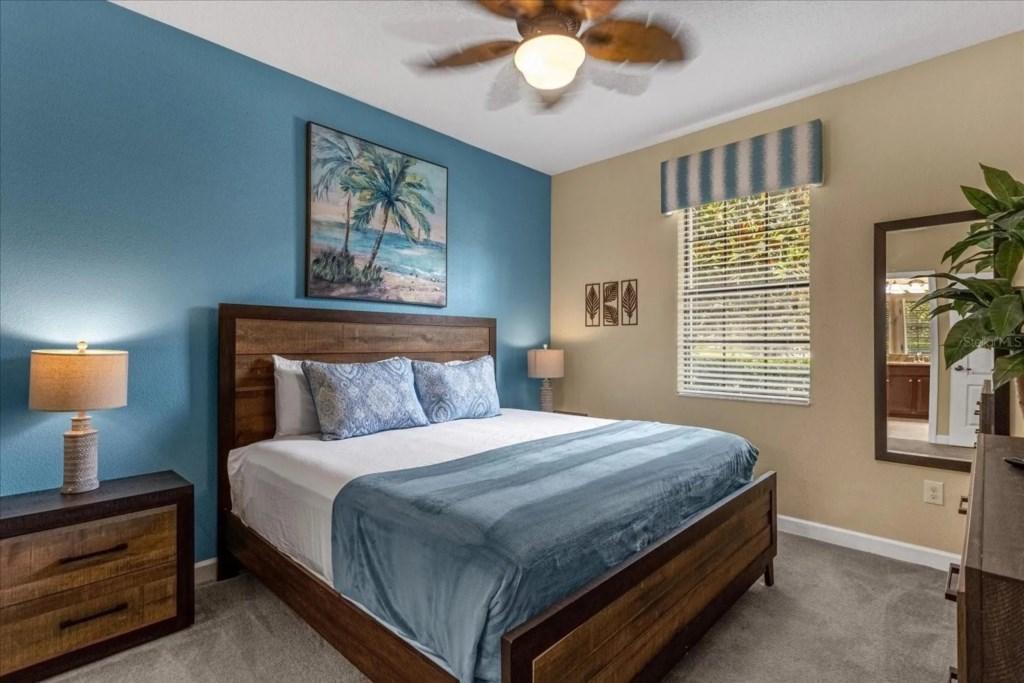
A guest bedroom with a wood bed frame, matching nightstands and one accent wall.
How many bedrooms the house has changes this list more than anything else. Our guide to furnishing a 4 to 10 bedroom vacation home shows what shifts at each size.
For the room around the bed, see our primary suite design guide. For the bed itself, read bedding and linen planning.
Living room
Seating for the full sleep count, even if some of it is an ottoman or an extra chair that can be moved.
Fabric that can be wiped or cleaned. We cover this in our durable furniture guide.
A TV on the wall at a sensible height, with the cables hidden, and a media console that doesn't tip when a child leans on it.
A rug that can be vacuumed hard and washed or replaced, not a delicate one.
A coffee table with rounded corners, because someone will run into it.
Lamps on switches that are easy to find, so the room feels warm at night and not like an office.
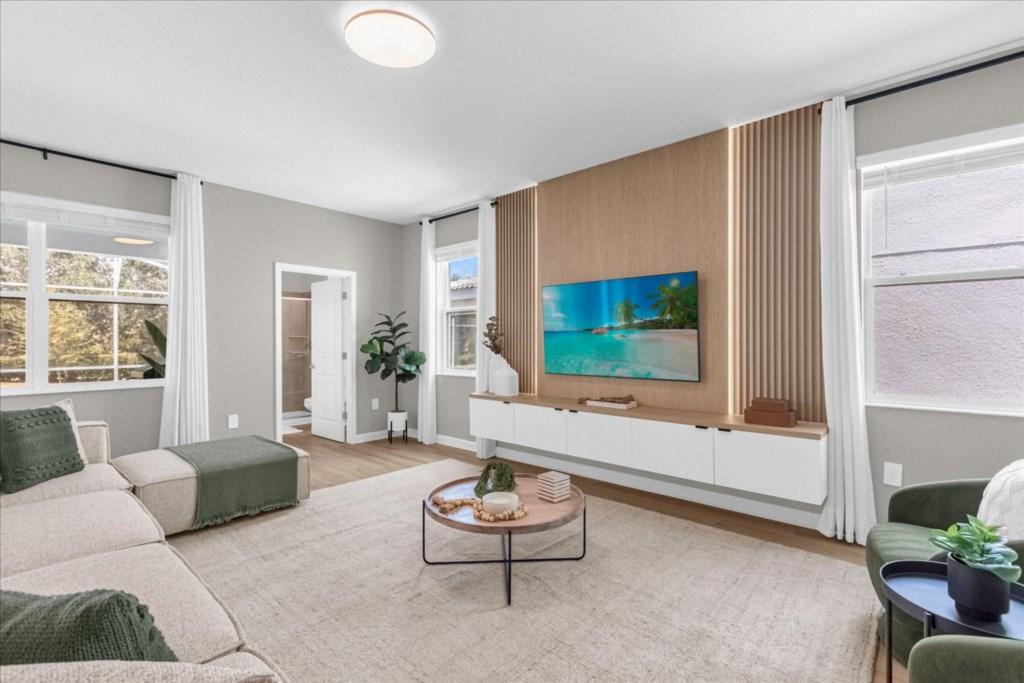
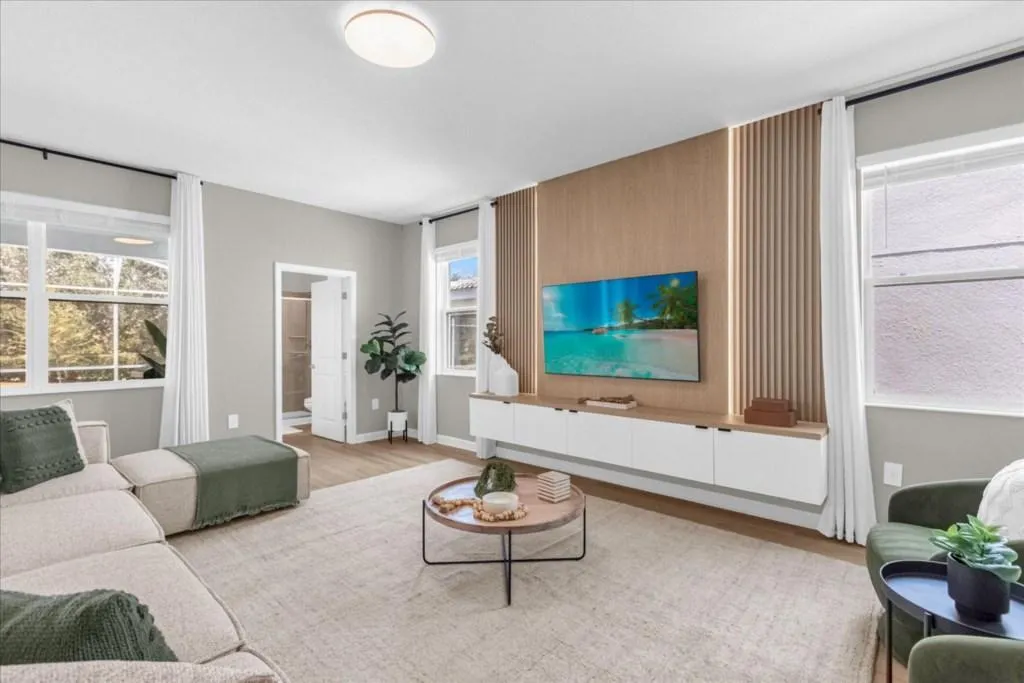
An open living room: a cream sectional, a slat wall behind the TV and a floating media console.
Dining and kitchen
Dining is where large groups either feel welcome or feel squeezed. Count the seats before anything else.
One table that seats the group, or a table plus a counter with stools. Add a bench or extra chairs for the children.
Chairs that can be wiped clean and are comfortable for a long breakfast.
A dining light that is bright enough for meals and has a dimmer for the evening.
The housewares list: pots and pans, knives, dishes, glasses, utensils, serving pieces, a coffee maker, a kettle, and a few storage containers. Match the quantity to the sleep count.
Small appliances that earn their space, such as a blender and a toaster, and a clear spot for them on the counter.
A trash and recycling plan that fits what the community collects, with a bin that is easy for guests to find.
For more on kitchens in rentals, read our kitchen design guide for Orlando vacation rentals. Our interior design for Orlando vacation rentals starts with your listing and the homes you compete with.
Seating a large group? See dining room planning.
Stocking a kitchen for a crowd? See kitchen setup for a large-group rental.
Bathrooms
Towels for each guest: bath, hand and a pool towel. Keep a spare set for the days between turnovers.
Hooks at the shower, the sink and the door. There is never enough hanging space.
A non-slip mat, a shower curtain or door that actually keeps the water in, and a proper trash can.
A hair dryer, tissues, hand soap and spare toilet paper in plain sight, so guests aren't hunting for them.
A mirror with good light at the sink.
Game room, loft, bunk room and themed rooms
This is where a house goes from "nice" to "the one the kids pick." It's also where the most money gets wasted when the plan starts with the theme and not the room. Our order:
Room first. Decide what the room has to do: sleep more people, hold a game table, or be a quiet hangout.
Layout second. Beds, walkways, seating, outlets and screens.
Theme third. Walls, lighting and built pieces on top of a layout that already works.
Maintenance last. Wipeable surfaces, a repair plan and a cleaner who knows how to reset it.
Our themed room decorating and game room design pages show how we build these rooms. If you're not sure whether a room should be themed at all, read themed room or standard bedroom.
Can only build one special room? Read themed room versus game room. If it's a bunk room, see our princess castle bunk room guide.
Pool, lanai and outdoor space
Seating for the sleep count, with a few spots in the shade.
Furniture and cushions that can handle sun, rain and chlorine. Cheap indoor pieces fade and split fast outdoors.
A tidy place for pool towels, floats and toys.
A table where people can eat outside, and lighting so the area is usable after dark.
A pool safety plan that follows the local and resort requirements. Check these before the first guest arrives.
Our pool area design guide goes through the layout in more detail.
Tech, safety and the details guests notice
Wi-Fi that reaches every room, with the network name and password on a card where guests will see it.
Smart locks, a thermostat and lighting scenes, if you want to manage the house remotely. See our smart home automation page.
Smoke and carbon monoxide detectors, a fire extinguisher and a first-aid kit, placed where the local rules and your insurer expect.
Door and window locks that work, and a plain set of house rules posted where guests will read them.
Extra linens, towels and supplies in a locked closet so the cleaners can reset the house between guests.
For kids' rooms and guests with limited mobility, see our guides to kids' room safety checks and accessibility-friendly design.
The last walk-through, then the photos
Before a photographer arrives, walk the house with your phone in your hand. Open every drawer, flip every switch, sit on every bed and check every outlet. It takes an hour and it finds the problems before a guest does.
Then shoot the photos. Daylight, tidy surfaces, every lamp on and the beds made. We cover this step in our guide to staging a vacation rental for listing photos.
The short version to keep on your phone
Sleep count, guest type, rules, finish level, who stocks what.
Bedrooms: bed, nightstands, lamps, blackout, mattress protector, outlets, luggage space.
Living room: seating for the group, cleanable fabric, TV and cables, a washable rug.
Dining and kitchen: seats for everyone, a full housewares list, a trash plan.
Bathrooms: towels, hooks, mats, supplies in sight.
Game and themed rooms: room, layout, theme, then maintenance.
Outdoor: shade, weatherproof furniture, a towel spot, evening light.
Tech and safety: Wi-Fi, locks, detectors, house rules, spare linens.
Walk-through, then photos.
Frequently asked questions
What should I buy first when furnishing a vacation rental?
Start with beds and mattresses, because they decide the sleep count and take the longest to get right. Then seating and dining sized to that number. Decor, themed rooms and photos come last.
How long does it take to furnish a vacation rental?
It depends on the size of the house, whether custom pieces are involved and when the deliveries land. Themed rooms and built pieces take longer than catalog furniture, so start those first. We'll give you a realistic schedule once we've seen your house.
Do I need to furnish everything at once?
No, but the sleeping areas, the living room, dining and kitchen have to be ready before the first guest. Feature rooms can come in a second phase if the house is guest-ready without them.
Who stocks the kitchen and linens?
That has to be decided up front. In a turnkey setup we can source and install furniture, decor and linens. Tell us what you want us to handle and what your team or cleaners will stock, and we'll write it down so nothing is missed.
Can I use this checklist if I live out of state?
Yes. It's written so you can approve each step from a distance. Our guide to furnishing from out of state explains how we handle deliveries and updates.
What's the biggest mistake first-time owners make?
Buying for the house they imagine and not for the guests who will book it. A house that sleeps a big group needs seating, dining and storage to match, not just more beds.
Get a quote for your home
Tell us about your home, the resort it's in and the rooms you have in mind, and we'll put together a plan and a quote. Get my quote or call us at 689-777-9954.
Supreme Interior Design, 3401 Commerce Blvd Suite I, Kissimmee, FL 34741.
